Insights
Trust: The keystone of healthcare transformation in the AI era
October 2025
Read More
https://devenv.dataflowgroup.com/news-item/trust-the-keystone-of-healthcare-transformation-in-the-ai-era/
Professionals crossing borders, building careers.
BusinessEmployers confirming talent, fast and at volume.
GovernmentMinistries and regulators shaping the framework.
Issuing AuthoritiesThe institutions that confirm every record.
Verification and support for professionals on the move.
Built upon trust. Discover the DataFlow story.
Our story, mission, and the people behind the network.
Explore open roles and life at DataFlow.
The latest DataFlow announcements and press coverage.
Conferences, webinars, and where to meet us.
Insights on verification, licensing and global mobility.
Our policies, leadership and accountability standards.
Lorem ipsum dolor sit amet, consectetur
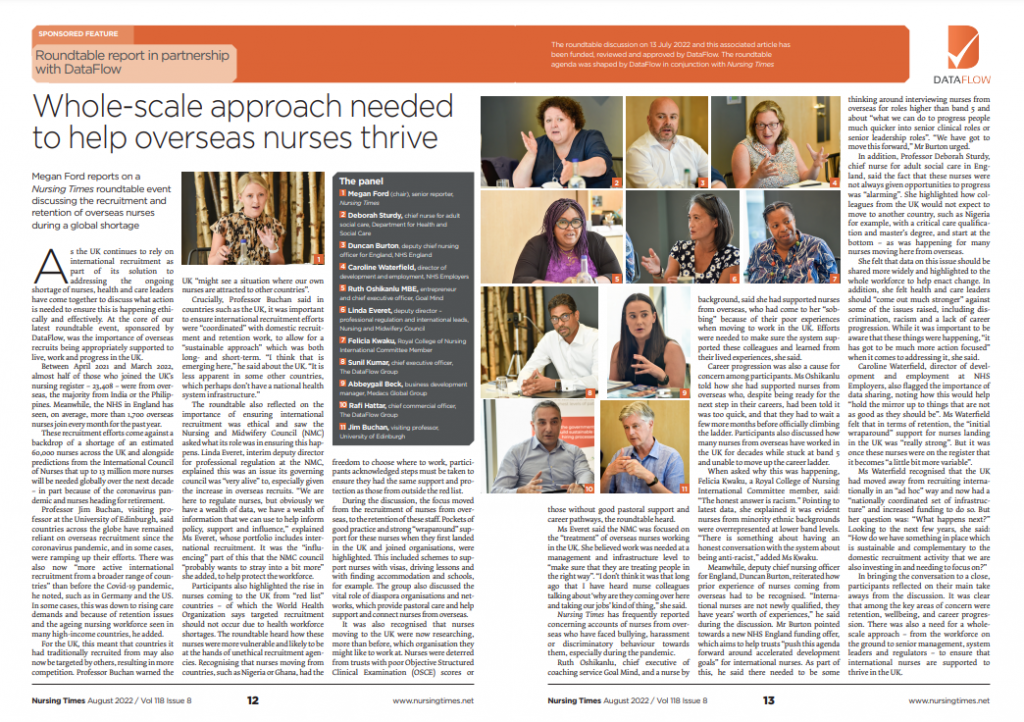
The latest DataFlow-sponsored healthcare roundtable event, brought 11 healthcare leaders and decision-makers within the UK’s National Health Service (NHS) together to discuss the importance of supporting international nurses to work, live and thrive in the UK successfully.
The healthcare roundtable, chaired by Megan Ford from the Nursing Times in London, focused on international recruitment as a partial solution to address the ongoing shortage of nurses in the UK. CEO of DataFlow, Sunil Kumar and CCO of DataFlow, Rafi Hattar, were in attendance.
Data presented showed that 23,408 international nurses from countries such as India and the Philippines joined the UK’s nursing register between April 2021 and March 2022. Over the past year, 1,700 international nurses have joined the NHS in England monthly.
The shortage of an estimated 60,000 nurses across the UK resulted from multiple factors, including the coronavirus pandemic and nurses leaving the workforce to retire. The International Council of Nurses predicts a global shortage of 13 million nurses over the next ten years.
Throughout the healthcare roundtable, discussions moved from competition between countries for hiring from overseas, coordinated international and domestic sustainable approaches, ethical international recruitment, staff retention, representation in the workplace, career growth, funding career development goals and continued pastoral care.
Professor Buchan said that a broader range of countries are ramping up their international recruitment efforts as they continue to rely on overseas talent since the pandemic. He also noted that, in some cases, this was happening due to issues with workforce retention and aging workforces, particularly in high-income countries. Competing for talent against other countries, Professor Buchan highlighted that the UK “might see a situation where our own nurses are attracted to other countries.”
Additionally, Professor Buchan said that international and domestic coordinated efforts would allow for short and long-term sustainable recruitment approaches, which he thinks are already emerging in the UK but “less apparent in some other countries, which perhaps don’t have a national health system infrastructure.”
Given the UK’s increase in hiring nurses from overseas, Linda Evert from the Nursing and Midwifery Council (NMC) discussed the importance of ethical international recruitment. “We are here to regulate nurses, but obviously we have a wealth of data, we have a wealth of information that we can use to help inform policy, support and influence,” said Ms. Everet when discussing how to protect the nursing workforce.
On this point, the roundtable discussed how nurses coming to the UK from “red list” countries – which targeted recruitment should not occur due to health workforce shortages – must receive the same support and protection as nurses not on the red list.
From there, the discussion moved toward staff retention and best practice to give international nurses pastoral care as well as schemes to support nurses with necessities such as accommodation, schools, visas, driving lessons, and networking opportunities to connect nurses from overseas.
Ruth Oshikanlu, a nurse by background, discussed how she has supported nurses who did not receive “wraparound” care and, as a result, had a bad experience when moving to work in the UK. Oshikanlu emphasized the need for various efforts to continue supporting nursing colleagues in the workplace and to support their career progression, so it’s not delayed.
Felicia Kwaku explained that the delayed career growth mentioned by Ruth Oshikanlu was due to a lack of representation for nurses of minority ethnic backgrounds at lower band levels.
Continuing the discussion of career progression and discussing a new NHS England funding offer to push accelerated development goals for international nurses, Burton addressed the need to interview international nurses for roles higher than band 5 so as “to progress people much quicker into senior clinical roles or senior leadership roles.”
Agreeing with Burton, Professor Sturdy highlighted how nurses from the UK would never expect to move to another country with a high level of training and career profession and begin their work at the bottom. She also urged that although there is awareness of these issues, “it has got to be much more action-focused.”
Caroline Waterfield highlighted how the initial support international nurses receive coming to the UK is really strong, but the support needs to continue. Looking to the future, Waterfield asked, “How do we have something in place which is sustainable and complementary to the domestic recruitment activity that we are also investing in and needing to focus on?”
The DataFlow roundtable panel concluded on the need to focus on plans to improve retention, increase well-being and facilitate the career progression of international recruits. Ultimately, a whole-scale approach is needed to ensure that international nurses who set their sights on a career in the UK are supported throughout their professional journey. This approach will only be successful with the combined efforts of colleagues, senior management, system leaders and regulators.
Insights
October 2025
https://devenv.dataflowgroup.com/news-item/trust-the-keystone-of-healthcare-transformation-in-the-ai-era/
Insights
January 2025
https://devenv.dataflowgroup.com/news-item/transforming-healthcare-verification-in-the-middle-east/

Insights
September 2024
https://devenv.dataflowgroup.com/news-item/the-role-of-accreditation-in-elevating-global-healthcare-education-standards/